Persian Cultural Fashion
-
Prize
-
PhotographerMir Kian Roshannia, Iran
-
Studio-
-
Website
Iran is a vast country containing many different ethnicities and
languages. As a result, the traditional dress tends to vary by region,
territory and sometimes even individual village. By in large, the majority
of the ethnicities pertaining to the regions of Iran, dictate the
traditional costumes. These include dress styles for Bakhtiaris, Baluchis,
Loris, Gilanis, Kurds, Ghoochanis, Ghashghahis, and others.
Image-1:---------------Mazandarani dress
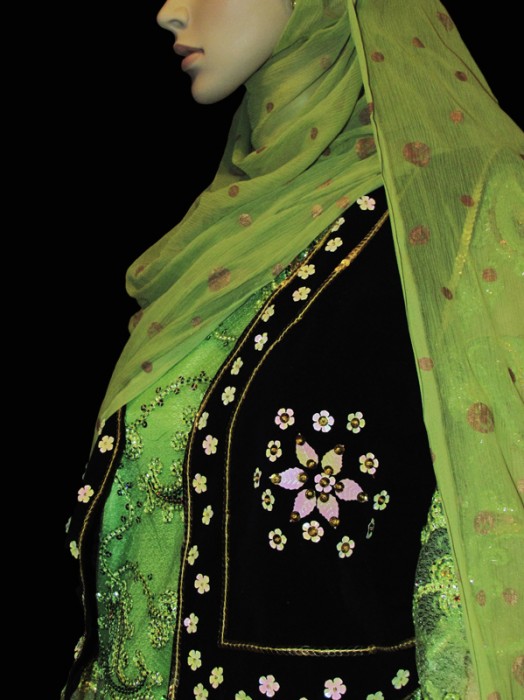
One of the most interesting traditional dresses is the Mazandarani dress.
The Mazandaran region lies to the north of Iran, in the area of the
Caspian Sea, north of Tehran. The region is filled with farmlands and
engages in agriculture. The costume of Mazandaran consists of trousers and
dress, like most regional dress. The distinguishing feature in the
Mazandarani dress, for women, is the skirt. It is usually much shorter and
much fuller than the usual traditional outfits. Depending on the occasion
and the time of year, the skirts can get quite short, and be likened to
puffy mini-skirts.
Image-2:------------------By far the most elaborate and diverse form of traditional dress comes from
the many Kurds who inhabit several regions of Iran. Since the Kurds live
in different regions, their clothes also tend to vary. There are the Kurds
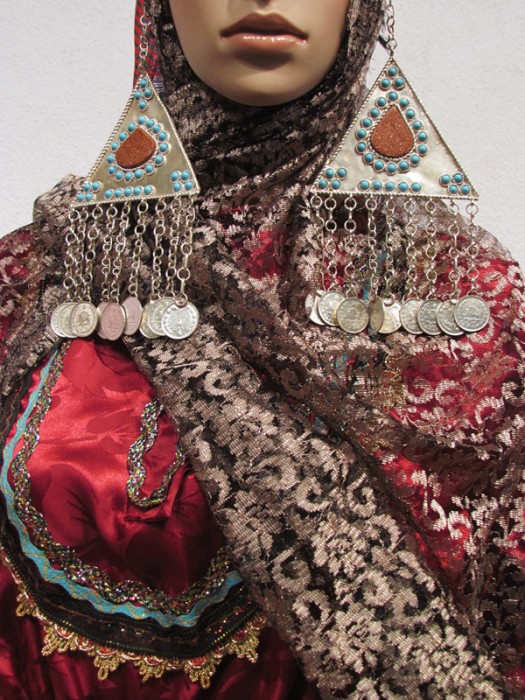
from Sanandaj, and also the kurds from Kermanshah. Kuridsh outfits tend to have headcoverings which are larger and more elaborate than other costumes. Both men and women commonly have belts which are very wide and tightly wrapped around the waist over the clothes to give the outfit some shape. Shirts, skirts, and trousers for both men and women tend to be very baggy and over-sized. Kurdish women tend to wear many coins and jewels which dangle on their forehead and are attached to a scarf or shawl.
Image-3:-----------------Torkaman dress
The Torkaman tribe in Iran, mainly coming from Turkey and having settled
in Iran, also have a distinct and special dress. The Torkaman dress in
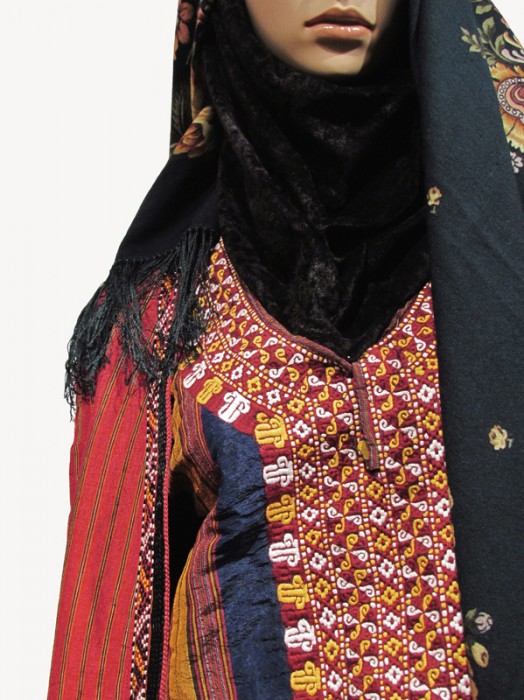
Iran for the women consists of a long dress with a long open robe.
Probably the most conceiling of fashions, the Torkaman dress generally
sports a face-cover. This can be in the form of a cloth that the woman
ties behind the ears and hangs just under the nose. Clothes tend to favor
rusty, and earthy colors, such as deep reds and dark browns.
Image-4:--------------The traditional Bakhtiari dress for women consists of a long
colorful skirt with many layers, and an additional apron-like material,
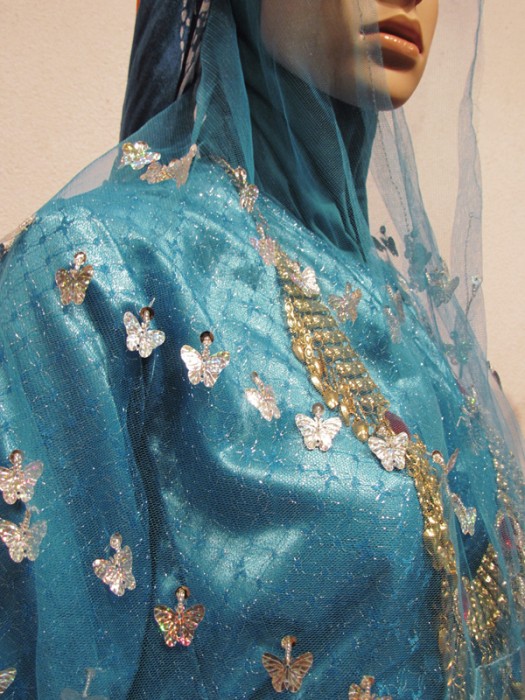
which is thinner and brighter. Bakhtiari women wear long scarves and wraps
which can contain ornaments and decorations sewn in from faux coins to
hand-sewn designs. Separate shirts are worn at the top with matching vests
or shawls. Bakhtiari clothes are versatile and protect the people from
weather and extreme conditions.
Image-5:---------------Another form of traditional dress stems from the Ghashghai
region. Women from this region wear, located in the south of Iran, wear
long skirts which are slightly more layered and offer much brighter
colors. This can be seen on the right. The shirts are usually lighter in
color and are sometimes entirely covered by the scarves worn on the head.
The Ghashghai head cover tends to be tightly closed at the bottom of the
chin with some sort of pin, for example a safety pin. A second
headband-like cloth may be wrapped around the head of the individual. This
cloth may be longer and hang from the person's head back over the
shoulder. Smaller ornaments such as coins may be hung from the forehead,
depending on the occasion.
-
BiographyBorn and raised in Tehran, graduate from dentistry and work as a dentist, interested in digital photography from 2004. Studied at "Tehran Fine Art University" Faculty of photography as a freelance student for 1 year and work as freelance photographer with interest in Fine Art. My conceptual work is a confluence of people, elements and landscape. After photographing these subjects, sometimes combine several natural images into one single image.
-
AwardsPHOTOGRAPHY CREDENTIALS: - FIAP Gold Medal Guller Ertan Turkey 2018 - IAAP Gold Medal Contrast Bosnia 2018 -Honorable Mention 6th Khayyam International Exhibition Of Photography Iran 2018 - Mull Gold Medal Contrast Bosnia 2017 - Gold Medal The 122th Toronto International Salon of Photography, Canada 2015 -Honorable Mention PX3 Prix De La Photographie Paris 2014 -Honorable Mention International Photography Award, USA 2013 -Gold Medal Tropical Image Int’l Exhibition, USA 2012 -FIAP Bronz Medal -14th International Photographic Art Exhibition- China 2011 -Gold Medal -Advertizing-Fashion PX3 Prix De La Photographie Paris France 2011 -Gold Medal -Press-Fashion PX3 Prix De La Photographie Paris France 2011 -Silver Medal -Press-Performing Arts PX3 Prix De La Photographie Paris France 2011 -1st Fine Art Category Winner People’s Choice Award PX3 Paris France 2011 -1st Fine Art Category Winner People’s Choice Award PX3 Paris France 2010 -2nd Place Fine Art Abstract PX3 Prix De La Photographie Paris France 2010 -Honorable Mention International Photography Award, USA 2010 -Honorable Mention PX3 Prix De La Photographie Paris 2009 -3rd Place Portraiture People’s Choice Award PX3 Paris 2009 -Honorable Mention International Photography Award, USA 2008 -Honorable Mention Tropical Image Int’l Exhibition, USA 2008 -Knack Photo Award Knokke, Belgium 2007