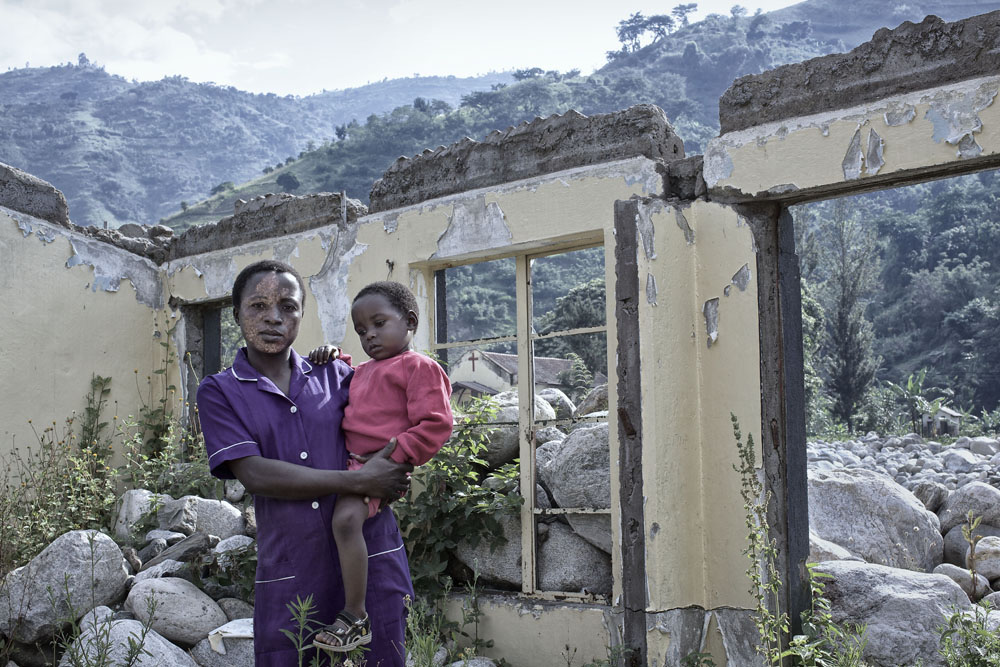
ABANDONED after the fury of the storm
-
PhotographerCarol Allen Storey, United Kingdom
-
Socials
-
Website
ABANDONED
after the fury of the flood
In May 2013 thrashing rain fell on the soil eroded Rwenzori
Mountains. Its fury cascaded into the River Nyamwamba leaving a
trail of destruction. Now the crippled community is coping with the
wrath,
especially the Kilembe Mines Hospital.
Sister Anna Mutazindwa, the head of nurses at the hospital said:
“Immediately after the disaster occurred there was support from
the Disaster Relief Emergency Funds. Within a few months they
departed with feeble follow-up or funding to mitigate the cause of
this natural disaster fueled by climate change. Most urgently, there
was virtually not enough money allocated for critical supplies that
were lost in the rage of the floods. Bed linens and uniforms were
ravaged and not replaced. The tangled twisted debris of metal
beds and other equipment are stacked up creating a breeding
place for vermin, an eyesore that clutters the grounds. Our wards
are over crowded; at times four adults share beds and many are on
mattresses on the concrete floor. Some patients are forced to
sleep outside the wards because of over-crowding. The hospital is
on a recovery mode but we are desperate for funding to rebuild
the nurses homes. My entire staff was displaced, and now are
suffering from acute financial pressure as they have had to find
alternative homes which is hugely expensive and, many, have not
been paid their wages for over a year forcing them to take loans
from the local bank at exploitive rates. We feel abandoned and
forgotten.”
The wider world had never heard of the Kilembe Mines Hospital,
other disasters and the presence of terrorism are what capture the
headlines in the global press.”
In spite of acute shortages and compromised reconstruction, the
hospital operates serving its community with a high standard of
care with very limited resources.
The primary challenge for the Kilembe Mines Hospital is to find
permanent accommodation for their staff, 100 families, with
homes that are conveniently located close to the hospital and are,
importantly ‘rent-free’. There are no significant initiatives for
immediate relief. The government has pledged to rebuild the
homes but that may take a decade! Beyond the human factor, the
supplies, from linens through to medical essentials including:
oxygen for all the wards, replacement of dilapidated beds. Lack of
trolleys and suction machines are compromising the daily service.
Clean water is in a crisis situation – ‘Crest Tanks’ (for rain water
collection) are needed for all the wards, currently there is only one
servicing the entire hospital. The hospital needs to provide meals
for the staff – Sister Anna said, as they are all starving!
Two years since the flood disaster, the Kilembe Mines Hospital
staff exhibits an admirable resilience, inspired by the support and
unswerving leadership of Sister Anna, the head of nurses. With a
quiet dignity, intelligence and empathy, she exudes optimism that
is contagious, embraced universally. She is a shinning example of
what humanity is, in spite of the unwarranted circumstances of the
forgotten flood disaster at the Kilembe Mines Hospital.
-
BiographyCarol Allen Storey is an award-winning documentary photo journalist specialising in chronicling complex humanitarian and social issues. “My images are intimate, about issues and citizens I deeply care about. I believe photographs may not be capable of doing the moral work for us, but they can trigger the process of social consciousness.” In 2000 Carol graduated Central St. Martins, Master Photography Programme with distinction. Storey’s further degrees include an MA at Columbia University and a BA at Syracuse University. A native New Yorker, Storey resides in London
-
Awards2020 Winner Julia Margaret Cameron Award 2020 Winner Photojournalism, Color Awards 2020 Finalist AOP Award photojurnalism 2019 1st prize series IPPAWARDS 2019 Association of Photographer, finalist portrait 2018. Lens Culture B&W finalist, juror’s choice 2018 Julia Margaret Cameron Award, nominee 2018 One Eyeland, Landscape finalist 2018 IPA 2nd prize editorial 22014 - PX3 Award Feature stories: ‘CROSSINGS’:Silver, ‘Fractured Lives’ and Bronze 2014 - International Spider Awards – nominee 2014 - Kontinent Awards finalist 2013 - New York Photography Festival finalist 2013 - Social Documentary annual award finalist 2013 - Kontinent Awards – Finalist documentary projects 2013 - ‘Act of Kindness Award – First Prize 2013 - International Spider Award - nominee 2013 - Taylor Wessing National Portrait Gallery Award - exhibition 2012 - Photo Annual Award – Motion Series Honourable mention 2012 - PX3 Prix De La Photographie Paris – Honourable Mention Altered Images 2012 - Photocrafti Award finalist 2012 - The Moving Walls International exhibition 2011 - The Press Photographer’s Year - finalist 2011 - Taylor Wessing National Portrait Gallery Award - exhibition 2011 - Lucie Foundation Scholarship – short listed 2011 - Social Documentary Competition - finalist 2011 - One Life International Portfolio Award – short listed 2011 - International Spider Award - finalist photojournalism and portrait series 2010 - New York Photography Festival – nominee single editorial 2010 - International Lucie Photography Awards – honourable mention three editorial essays 2010 -International Spider Awards – finalist photojournalism and portrait 2009 - International Spider Award - finalist photojournalism and portrait series 2009 - Taylor Wessing National Portrait Gallery Award – exhibition 2009 - New York Photography Festival - finalist 2008 - The Press Photographer’s Year – finalist 2008- International Spider Awards - finalist for photojournalism