Maro Kouri
PX3 Prix de la Photographie Paris 2025 – State of the World
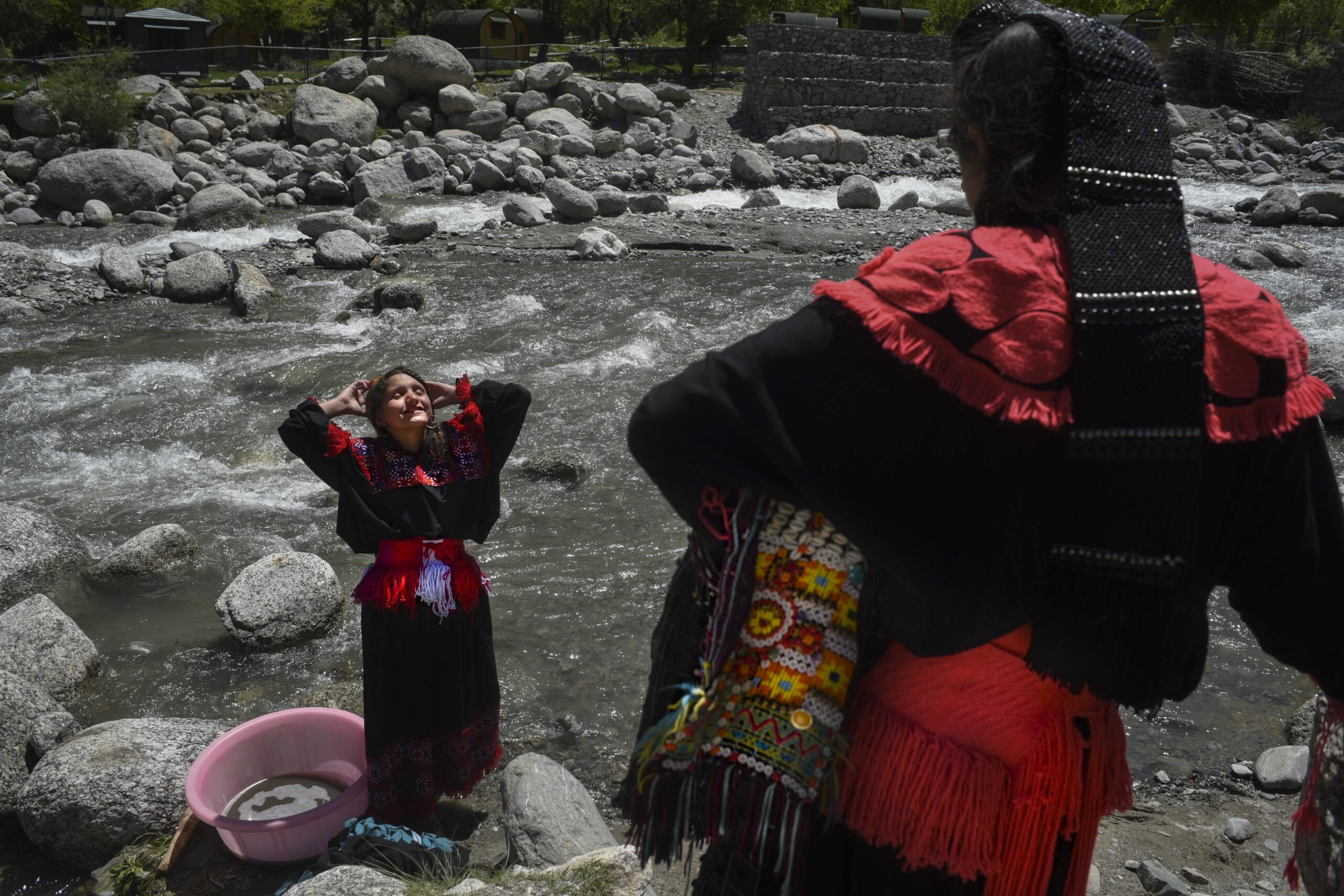
Curatorial Selection – The Kalash: Challenging Tradition and Religious Conformity
Can you take us behind the scenes of your winning series? What was the story you aimed to tell, and did any unexpected moments shape the final result?
In recent years — since my youth as a photojournalist — there has been a woman, I used to meet by chance every year during the annual ball of my father’s village Arna, a beautiful village near Sparta, on the slopes of Mount Taygetos. She was part of — and closely followed — a group of volunteers who were supporting the Kalas tribe on many levels: they built a school, a hydragogeio (water system), a museum, and other community projects that helped preserve and uplift the tribe’s cultural and daily life. She often invited me to join her on her journeys there — to visit this ancient community said to be descendants of Alexander the Great. One day, she told me: “I’m going there for the last time.” And so, I decided to go with her. I organized a Photographic Workshop, feeling the deep need to share my experience and inspiration as a photojournalist — in a country where tourists are only about 7% of the population, y experience in Pakistan was transformative. The people are incredibly hospitable, luminous, and generous, and the country itself remains untouched — free from the industrial tourism and the cold architecture of globalization that often erases our roots and identities. and in the remote, rugged mountains WOMEN STAY FREE TO …..just a few kilometers from Taliban territory. There, in those steep and sacred landscapes, this ancient tribe continues to survive, to live with dignity — and most importantly for me — where women still keep the sacred circles alive – a living symbol of sisterhood, connection, and mutual support. They are the answer to the patriarchal archetype that,HAS FAILED, as history shows us, has led humanity again and again into violence, wars, and division. The antagonism between women must be healed. We, as women, need to connect, to share, to nurture our togetherness — so we can express the gifts that we carry: creativity, tenderness, equality, and beauty. As a photojournalist MENTOR , AND 4D DREAM COACH I always feel deeply connected to the stories I tell. It is my apostoli — my calling, my life’s PATH. Through photography, I can share with the world the voices and messages of people like the Kalas — messages of unity, ancient wisdom, dance, and purity.
How has receiving recognition from The State of the World competition influenced your perspective on the role of your work in today’s global dialogue?
Global dialogue begins with dialogue with the Self — or as we say in Greek, with the “eafto.”
After three decades of traveling the world on photojournalistic assignments — mostly in ancient lands across Asia, Africa, Australia, the Māori’s land-New Zealand and Argentina, I have realized that the most important journey is the Inner Journey.
It is the journey of healing — recognizing, acknowledging, and caring for our personal and collective traumas until they can be transformed and released. Only through this process can we reach forgiveness, which I believe is the ultimate form of salvation.
Through the art of photojournalism, this has become my path, a way to connect the outer world with the inner one, and to contribute to a more compassionate and conscious global dialogue.
Photojournalism often demands vulnerability – from both subject and photographer. How do you approach capturing truth while maintaining empathy and respect?
Yes — to go deep into my own vulnerability and to accept her, becomes my strength to go further, to continue my path.
To see myself and to truly listen to my vulnerability, is empowering.
If I can do this with my best friend, myself, with my inner child. Then I can do it with everyone I want.
When the spring of pure water inside me is full, then I can share it with others. But if the source is empty, there is nothing to give.
In this work, vulnerability and empathy are essential.
As a photojournalist, you must be able to step into another person’s shoes — even if it’s someone you disagree with, or even someone you dislike. To understand the need behind someone’s actions, even when they do something wrong, and cruel, is empathy. It doesn’t mean accepting or justifying — it means understanding the need, the trauma.
When people feel your openness, they open too.
And then, photography becomes a pure connection and a space of authenticity, honesty, and truth.
Those are the “clicks of our hearts”!
What motivates you to continue capturing the world through your lens, and where do you hope to take your work in the future?
The art of Photojournalism requires three essential thing to preserve: your innocence, your curiosity -from the Greek “periergeia” so, ‘peri to ergon,’ means” to move around the work”, and, as I mentioned before, your empathy.
I like to call it Photographic Empathy.
In recent years, I have felt a deep need to work with peer groups, because photojournalism is often a lonely path. You are always alone with your camera, your vision, and your inner world. I had long dreamt of working in community — so, workshops and retreats naturally appeared on my path.
Through these workshops, I share my experience: how I photograph in the face of the unknown: tribes, faces, challenges, extreme weather, and all the distances that take us far away from the comfort zones that Western civilization often uses to “de-press” us. All the technical details, to learn to photograph with light equipment, just prime lens, the body -posture, and breath works of course, to stay with yourself, focus!
In those moments, far from what is familiar, we connect — through the click of our hearts.
Alongside photojournalism, my other path as a 4D Dream Coach has also entered these workshops. Together with the participants, we meditate, share, and follow self-explorative healing structures. Every evening, even when we are camping in the jungle, we project our photographs on a screen — and in those images, we recognize our own reflection.
My dreams are to create a photographic book, an exhibition, and a documentary that gathers the lessons of my life’s journey.
For the last twenty years, my two daughters — from babyhood until now, when they are grown and following their own paths — have been by my side everywhere I traveled, except in dangerous zones. Many people used to believe the limiting pattern:
“You can’t follow your dreams if you have children.” But that’s a big lie.
They went to the best school in the world — the school of life — and I remember even their teachers agreed!.
So yes, whoever feels this resonance and wishes to support me, I invite them to connect: whether for the book, the exhibition, for photo assignments that have become financially challenging lately, or for the workshops I continue to lead and facilitate around the world — from Cappadocia, where we practice Sufi whirling to empty our minds before photographing, to Oman, the tribes of Africa, Asia,, Argentina.
How do you find balance between aesthetic vision and factual storytelling?
Aesthetic as a Way of Being
Aesthetic is a way of being — on all levels.
Harmony is my teacher, and Nature my mentor.
Nature itself teaches us about harmonious composition — about balance and equilibrium, about the perfect proportions between forms.
Look at the mountains, the hills, the trees, the flowers, the animals — even the homes built by past generations who respected their own nature. They created dwellings that were perfectly balanced with the landscape and its natural resources.
Nowadays, some “minds” might call you crazy if you refuse to eat dead bodies, or if you stand up for trees when they are being cut down to build concrete empires.
But aesthetic is a lifestyle — it is a way of seeing, living, and being in harmony with all that surrounds us.
As I often say: “We are what we photograph.”
So, as a professional photojournalist, I offer my art to every kind of need — whether it’s for an editor, a curator, a couple seeking a wedding photographer, or a store owner who needs images for a declaration or publication.
And if you want to understand what I mean by true aesthetic, just watch Tarkovsky’s films.
Let Tarkovsky play silently on your TV — and every time you pass by, you will see an amazing composition. Even without words, your eye will be educated.
Now, the best place to practice this creative challenge of harmony is within chaos — in Africa or Asia.
You know, it’s too boring to do photojournalism in a perfectly organized city, except of course the poor neighborhoods where life is rich because it is alive! Treasure is hidden in ourselves not in our pockets.
Headshot credit: Meeri Koutaniemi