Ian Flanders

PX3 Prix de la Photographie Paris 2025 – State of the World
Curatorial Selection – Cease Fire Now!
How has your personal background or life experiences influenced the global issues and stories you choose to capture through your photography?
To be honest, my personal background doesn’t have a major influence other than being a very curious person. For example, if somebody tells me “don’t look there” the first thing I’m gonna do is look there!
I first became interested in documentary style photography after discovering the work of Stephen Dupont. It was the first time I had seen photojournalism mixed with an artist’s touch and his incredible gift of storytelling with a sense of humanity.
Mix that influence with my introverted personality, the camera takes me into peoples lives I would never encounter due to my social anxiety.
What first drew you to the story behind your winning series, and how did it evolve from initial idea to final image?
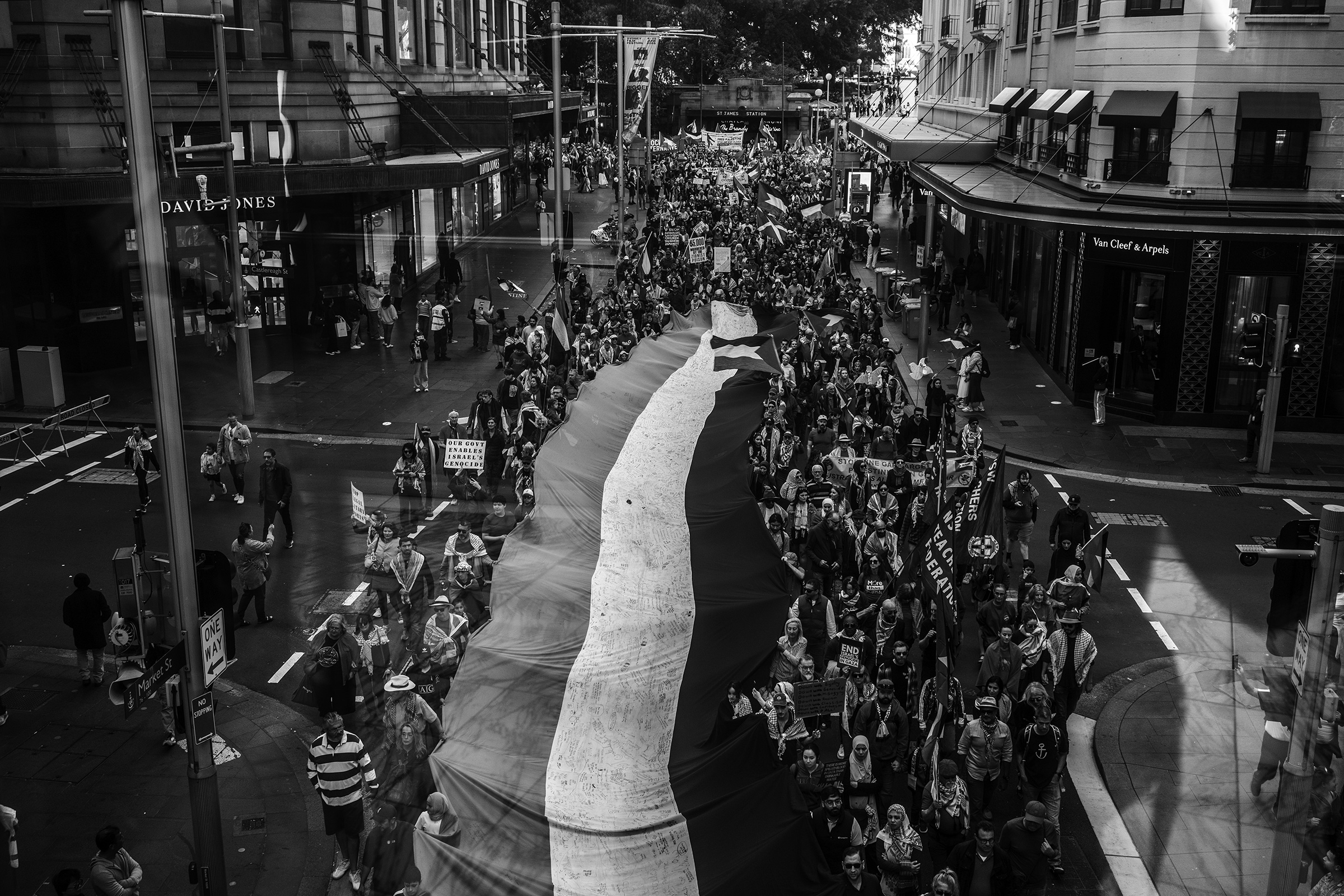
This is a good follow-up question because as I previously mentioned using the ‘don’t look there’ metaphor this was exactly what was happening to the Palestinian community in Australia, and all around the world to be honest.
I simply didn’t believe the fear mongering by our politicians and the NSW police so I went to the protest to make up my own mind, to hear what the Palestinian people had to say. From that point on the project grew organically in the way I photographed it, and what I have come to understand more than ever, is the saying “we don’t take photos, we are given them.”
The Palestinian community have given me this moment.
Your work highlights some of the most crucial and pressing issues in today’s world. How do you balance technical precision with the raw emotion needed to create a powerful, thought-provoking image?
This is a fair question. I say that because prior to this body of work I would’ve said I don’t care about the technical side but I had to buy a faster processing camera due to the nature of photographing protesters such as quick movement and variable light. In saying this, ‘a tradesmen never blames his tools’ and I’ll forever be drawn to the human emotion over the so-called rules of framing or aperture and ISO must be this or that.
When working on long-term projects, how do you sustain your curiosity and emotional engagement without becoming desensitized to the stories you tell?
I’ve completed three long-term projects in 15 years. Which hopefully is an indication of how rare it is find a project that truly encompasses you. Once you feel that profound connection, then it’s very easy to be committed. In each occurrence you get to the point where you can’t stop, you can’t not go to photograph.
Looking ahead, are there any social or environmental themes you feel compelled to explore further through your work?
Documenting within the Palestinian-Australian and Arab communities for the past two years on a weekly basis has had a profound effect on me as a person and this has already guided me into other projects. I am gonna let my photography progression grow organically.
In short, I’ll always be drawn to photographing people whose voice isn’t being heard.